
Techfullpost

Entertainment

Gears of War: E-Day Xbox Controller Sparks Backlash Over Steep Price

Gears of War E-Day controller

Microsoft has unveiled two Gears of War: E-Day Limited Edition Xbox controllers timed to the October 6th release of “Gears of War: E-Day,” and the reveal has split gamers between admiration for the design and frustration over the price.

The controller features 3D sculpted grips styled after cracked, crackling volcanic rock, paired with a bright red center panel bearing the Gears of War logo. Transparent red buttons and a matching D-pad reinforce the aggressive look, while leather-like material on the back and side grips is meant to add comfort during extended play sessions. Microsoft is also selling a matching E-Day version through Xbox Design Lab, along with a coordinating E-Day 8BitDo Ultimate charging dock. The controllers themselves carry a rated battery life of 40 hours.

Pre-orders for the Gears of War: E-Day Limited Edition controller are open now on Microsoft’s website for Xbox Series X|S, PC, and cloud gaming. The release date is set for September 30th, 2026, ahead of the game’s own launch.

Fans praise the look, question the cost

Early reaction to the controller’s design has been largely positive. One fan called it “what beauty, what art” in a post on X. A Reddit user offered similar enthusiasm, writing that they weren’t expecting to buy another Xbox controller before seeing this one. Across social media, the visual design of the controller has drawn little criticism. The disagreement centers entirely on what Microsoft is charging for it.

The controller is priced at $89.99 for pre-order, a $25 jump from the standard $64.99 price of a normal Xbox controller. That gap has driven much of the pushback online. One Reddit user reacted to the price by comparing it unfavorably to Microsoft’s Forza and Doom-themed controllers, calling the cost “insane” for a limited edition release. Another commenter argued the controller was “purely meant for collectors” and predicted most players would skip it.

Part of the frustration stems from how gamers weigh the controller’s long-term value against its price. Critics online have pointed out that $89.99 is a steep amount to spend on hardware that could develop stick drift or otherwise wear down within a few years of regular use, the same durability concerns that affect standard controllers regardless of price point.

Microsoft’s pricing for the Gears of War: E-Day controller isn’t without precedent. The company’s Forza Horizon 6 Limited Edition controller launched at the same $89.99 price point, suggesting Microsoft has settled on that figure as its standard rate for premium, game-branded controllers rather than pricing this release as an outlier.

Players unwilling to pay the premium do have other options. A range of third-party Xbox controllers offer lower price points for those looking to skip the licensed design in favor of standard functionality, though none will carry the Gears of War: E-Day branding or matching accessories Microsoft built specifically around the game’s October launch.

Whether the backlash affects actual sales remains to be seen. Limited-edition, game-branded controllers tend to draw interest primarily from collectors and dedicated fans of the franchise rather than the broader Xbox player base, a pattern that held true for previous releases like the Forza Horizon 6 edition despite similar complaints about pricing at launch. With pre-orders already live and the September 30th release date approaching, gamers weighing whether to buy will have several weeks to decide if the design justifies the added cost.
ADVERTISEMENT
RECOMMENDED
Entertainment

AI “slop” studios chase Nolan’s Odyssey with cut-rate cash grabs

By George Mensah 4 min read

Christopher Nolan’s adaptation of The Odyssey opens in theaters this weekend, with early projections putting its opening haul between $80 million and $100 million over just a few days. Audiences are turning out to see how Nolan applies his signature filmmaking techniques to Homer’s epic. At the same time, another studio is trying to draft off that excitement to promote a very different take on the same story.

On Tuesday, film studio Fountain 0 announced an AI-generated version of The Odyssey titled “Odysseus: The Fall,” set to become available for digital rental or purchase later this summer. The project comes from director Ash Koosha, who previously worked with Fountain 0 on “Dreams of Violets,” an AI-generated docudrama about civil unrest and state violence in Iran between late 2025 and early 2026. That earlier film reportedly cost around $2,000 to produce. “Odysseus: The Fall” carries a similarly small budget, described as being in the “mid-five figures,” compared with the roughly $250 million Nolan spent making his version.

AI tools built the film’s look

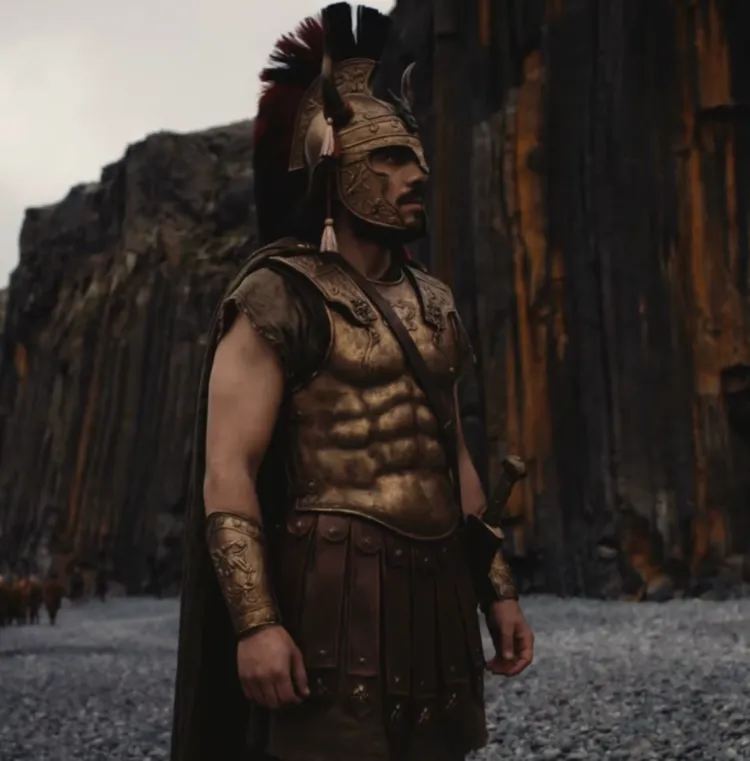
The trailer for “Odysseus: The Fall” shows what Koosha built using Kling’s AI video generator and Google’s Nano Banana tool. The shots run short, and the visuals carry the glossy, slightly artificial look common to AI-generated video. Koosha modeled the character of Odysseus after his own likeness and voices every character in the film himself. Even so, the figures move and speak with a stiffness that makes them read as clearly AI-made rather than human performances.

Fountain 0’s timing makes its intentions fairly clear. Releasing an AI-made Odyssey adaptation the same summer as Nolan’s big-budget version gives the company a way to market its production technology while offering what amounts to a low-cost alternative to a film people are already anticipating. Fountain 0’s executive chairman, Tom Rogers, told Variety that the project targets people who might not “like going to the movie theaters, but have a real interest in AI and what’s going on.”

That framing positions “Odysseus: The Fall” less as an independent artistic take on Homer’s story and more as a demonstration of Fountain 0’s AI production process.

A comparison Rogers seems eager to invite

Rogers went further, suggesting the release of his company’s film could actually drive interest in Nolan’s version. “We actually think, when our film is released, that it will be a catalyst for a lot of people who might not otherwise have seen the Odyssey to hopefully go see it, so they can compare the state of the highest state of human filmmaking achievement, which I truly expect the reviews to suggest Nolan’s film is, with what the top state of the art is in AI filmmaking today,” he said.

Rogers stopped short of claiming his film could compete with Nolan’s on quality. Instead, he framed Fountain 0’s work as representative of what AI-driven filmmaking can currently achieve. Whether that claim holds up is a separate question. “Dreams of Violets” plays like a sequence of individually generated clips strung together, and it’s difficult to imagine audiences who pay for movie tickets finding that comparison flattering to Fountain 0.

What Nolan’s film has that AI hasn’t matched

Nolan’s “The Odyssey” reflects the work of hundreds of people collaborating across departments, from cinematography to production design to sound. Fountain 0 has emphasized that Koosha and his brother Pooya handled most of the work on “Odysseus: The Fall” themselves, treating that as a selling point. But a small production team isn’t typically what draws audiences into theaters.

There was at least an argument, however debatable, that “Dreams of Violets” served a documentary purpose by drawing attention to human rights violations in Iran. “Odysseus: The Fall” doesn’t have that same justification. It reads more as a marketing exercise for Fountain 0’s AI capabilities than an attempt to say something new about Homer’s story.

Part of a wider pattern

Other AI ventures have made similar moves recently. ElevenLabs released an AI-narrated audiobook version of “The Odyssey” using a synthetic voice modeled on Michael Caine. Separately, studio and startup Particle6 has spent months promoting “Tilly Norwood,” an AI-generated performer it describes as an “AI actress,” and recently announced plans for a feature-length film built around the character.

Fountain 0 and Particle6 appear to share a strategy: generate attention through novelty and controversy first, then hope that visibility translates into acceptance as legitimate entertainment products. What both companies seem to miss is that audience enthusiasm for a film like Nolan’s “The Odyssey” comes specifically from the collaborative, human-driven process behind it, the thing their AI-generated alternatives are explicitly designed to skip.

Human filmmaking still drives the conversation

The mix of strong praise and sharp criticism directed at Nolan’s film reflects his skill at making work that provokes real emotional reactions from audiences. Those reactions fuel the discussions and debates that get people buying tickets, which in turn keeps studios like Universal financially invested in big theatrical releases.

Generative AI’s advocates have promised for years that the technology will reshape entertainment. So far, none of their releases have generated anything close to the anticipation surrounding Nolan’s adaptation. Based on what Fountain 0 and similar companies have shown, that gap isn’t likely to close through marketing stunts timed to piggyback on someone else’s release.

Entertainment

Google’s AI enabled me to create subpar Nintendo knockoffs

By George Mensah 4 min read

This week, Google quietly offered a glimpse into a future where artificial intelligence can generate entire 3D worlds on demand—and the results were equal parts fascinating and deeply flawed. Using an experimental tool called Project Genie, I was able to create rough, AI-generated knockoffs of iconic video game environments, including worlds that looked suspiciously similar to Super Mario 64, Metroid Prime, and The Legend of Zelda: Breath of the Wild.

The experiences were amusing, sometimes impressive, and often bizarre. They were also a reminder that while AI world-building is advancing quickly, it remains a long way from delivering anything close to a polished, playable game.

Project Genie is built on Genie 3, Google DeepMind’s latest “world model,” a type of generative AI designed to create interactive virtual environments based on text prompts or images. Google first revealed Genie 3 last year, but access was limited to a small research preview. Starting this week, Project Genie is rolling out more broadly to Google AI Ultra subscribers in the United States, marking the first time many users can directly experiment with the technology.

According to Google, the goal is exploration rather than immediate productization. “It’s really for us to learn about new use cases that we hadn’t thought about,” said Diego Rivas, a product manager at Google DeepMind. Potential applications range from visualizing scenes for filmmaking and building interactive educational tools to helping robots learn how to navigate real-world environments. Still, Google is careful to temper expectations. “This isn’t an end-to-end product we expect people to use every day,” said research director Shlomi Fruchter.

Using Project Genie is straightforward. Users can choose from a selection of pre-designed environments or write prompts describing the world and characters they want to create. After a short processing delay, Genie generates a thumbnail preview and then renders a fully explorable environment. Each world lasts just 60 seconds, runs at roughly 720p resolution, and targets about 24 frames per second. Navigation is simple: WASD keys to move, the space bar to jump, and arrow keys to control the camera.

The problem is that the experience often feels more like a technical demo than an actual interactive world.

One Google-designed environment, called Rollerball, places the player in control of a blue orb rolling across a stark, snowy landscape, leaving a trail of paint behind it. There are no objectives, no sound, and no clear sense of progression. Input lag is severe, making movement feel sluggish and unresponsive—worse than many cloud-gaming services. Over time, the world begins to feel unstable: paint trails disappear, mechanics stop working, and the environment fails to remain visually consistent.

Another environment, Backyard Racetrack, offers slightly more structure with a defined course to follow. While marginally more engaging, it suffers from similar issues. Portions of the track unexpectedly morph into grass mid-run, breaking immersion, and vehicle details appear poorly rendered. The lag makes precise control nearly impossible.

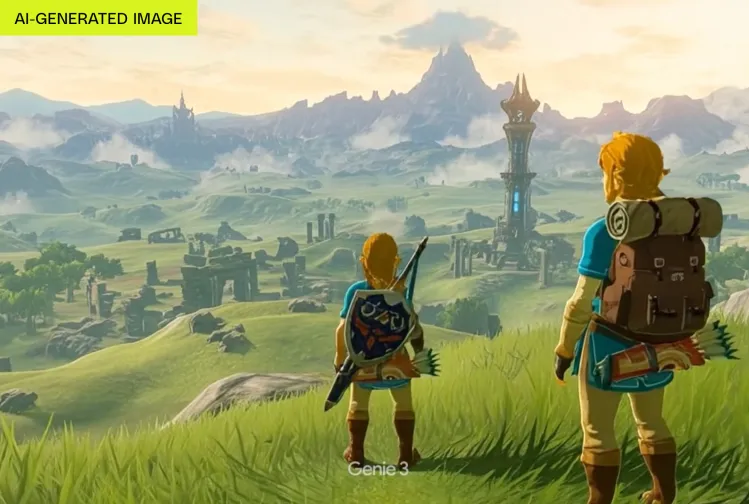
Where Project Genie becomes more entertaining—if not more useful—is when users push it to its limits. Prompting the system to generate worlds inspired by well-known gaming franchises produced crude but recognizable results. A Mario-like platforming environment, a Metroid-style sci-fi landscape, and a Zelda-inspired open world complete with a paraglider all emerged, though none offered meaningful gameplay. There were no goals, scores, enemies, or challenges—just space to wander and jump.

Even that limited interaction was frequently undermined by lag and inconsistency. At times, character controls stopped responding entirely, leaving only camera movement. The worlds often felt like they were being re-imagined frame by frame rather than remembered as a coherent space.

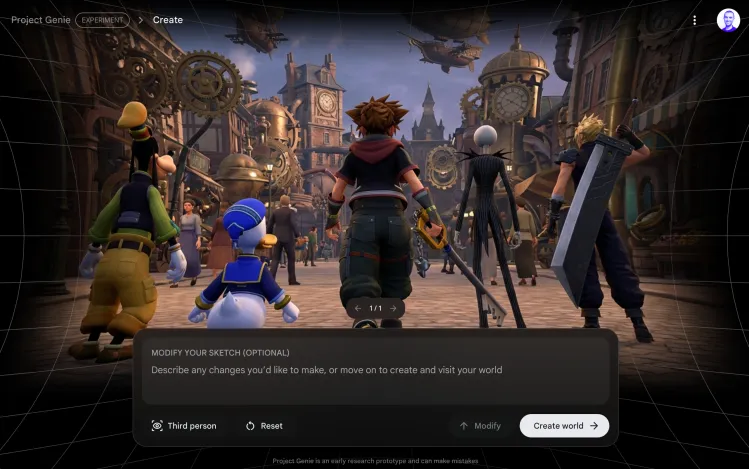
Notably, Project Genie showed inconsistent enforcement of intellectual property boundaries. While it allowed the creation of Nintendo-inspired worlds initially, it blocked attempts to generate a Kingdom Hearts-style environment, even when specific character names were removed and replaced with descriptions. In one case, Genie generated a thumbnail featuring characters that looked nearly identical to Disney and Square Enix properties, only to block the full experience from rendering.

Rivas explained that Project Genie is designed to follow user prompts and that Google is closely monitoring feedback. He added that Genie 3 was trained primarily on publicly available data from the web, which may explain why certain character behaviors—like gliding in a Zelda-like world—emerge organically from patterns the model has learned. Shortly before publication, Google began blocking Mario-themed generations altogether, citing the “interests of third-party content providers.”

Even setting IP concerns aside, Project Genie struggles as an interactive medium. The strict 60-second limit, unreliable controls, lack of audio, and frequent visual inconsistencies make it difficult to stay immersed. Compared with handcrafted video games—or even simpler indie experiences—the gap in quality is substantial.

Project Genie is undeniably more advanced than similar AI world-generation tools available just a year ago. But it still feels like a prototype searching for its purpose rather than a technology on the verge of mainstream adoption. Fruchter has spoken about a future where the lines between games, film, and interactive media blur, but for now, that vision remains distant.

Perhaps expectations should be adjusted. Project Genie is, by Google’s own description, an experiment. And like many early AI demonstrations, it’s better at sparking curiosity than delivering lasting engagement. For now, at least, AI-generated worlds are more interesting to peek into than to stay inside—and the genie, it seems, is still firmly in the bottle.

ADVERTISEMENT
Receive the latest news

Subscribe To Our Weekly Newsletter

Get notified about new articles