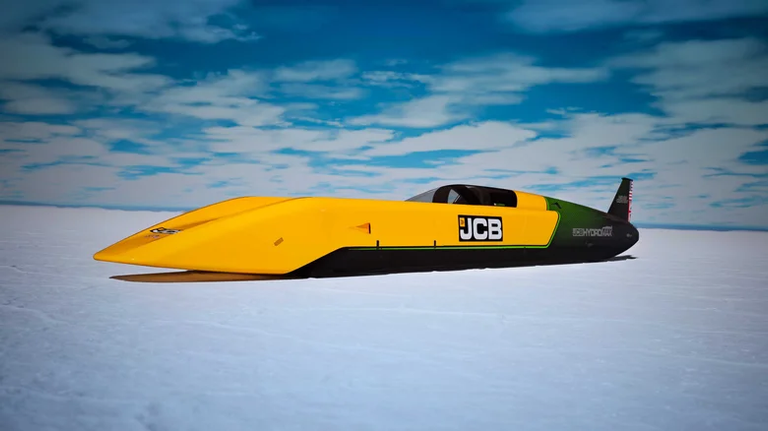
British engineering company JCB has broken the world land speed record for a hydrogen-powered vehicle, sending its Hydromax streamliner across Utah’s Bonneville Salt Flats at an average of 406.320 mph.
The FIA, motorsport’s global governing body, requires two runs over a mile-long course, one in each direction, completed within an hour, with the final result averaged between them. Hydromax covered its first run at 400.623 mph and its second at 412.135 mph on August 11, giving it the record average. That figure more than doubles the previous FIA hydrogen benchmark of 185.5 mph, set by the BMW H2R back in 2004.
A Digger Engine at 400 MPH
Hydromax also beat JCB’s own world diesel land speed record of 350.092 mph, set by its earlier car, the Dieselmax, in 2006. This time, the car produced no carbon dioxide from its exhaust.
The twin-engine, 32-foot streamliner runs on two production-based hydrogen combustion engines, 4.8-liter turbocharged four-cylinders that JCB also fits into its diggers and generators. Developed in just over 15 months with support from engineering firms Ricardo and Prodrive, the car isn’t built around a bespoke racing motor. The engines under its hood are close relatives of the ones already sold to construction customers.
Before the record run, Hydromax posted a Southern California Timing Association-certified mark of 368.347 mph at Bonneville Speed Week, placing it in the Blown Gas Streamliner class. That set up the FIA attempt days later.
Andy Green Behind the Wheel Again
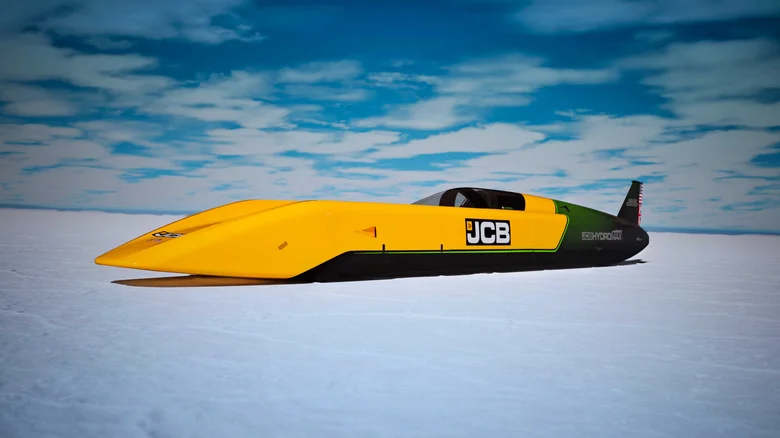
Wing Commander Andy Green, a former Royal Air Force fighter pilot, drove Hydromax to the new record. Green already holds the outright world land speed record, having driven the Thrust SSC to 763.035 mph in Nevada’s Black Rock Desert in 1997, the only car ever to break the sound barrier on land. He also drove JCB’s Dieselmax to its 2006 diesel record.
“Bonneville is the spiritual home of the world land speed record, and JCB Hydromax has just written itself into that history,” Green said. “The car was terrific: stable, strong and fast. Setting a world land speed record with hydrogen power, twenty years after Dieselmax, is a huge privilege.”
Marketing With a Purpose
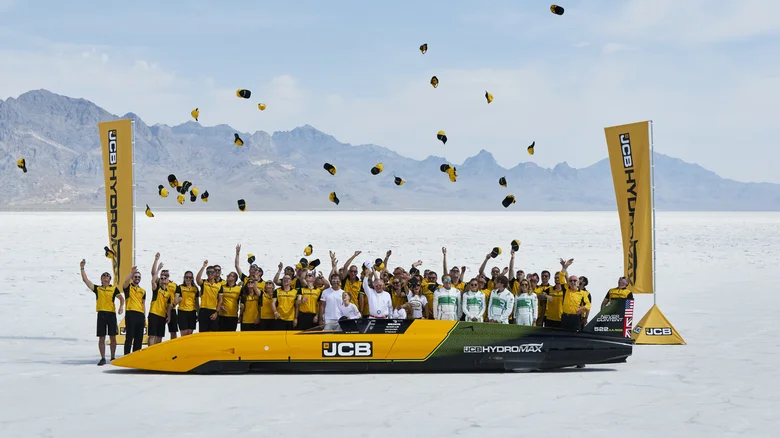
For JCB, the record serves a purpose beyond bragging rights. The company has poured roughly $130 million into developing hydrogen combustion technology as an alternative to both diesel and battery power for heavy machinery, and the engines in Hydromax are meant to demonstrate what that investment can do.
“This record was set by production-based engines, the same engines powering JCB diggers right now,” said JCB chairman Anthony Bamford. “That is the point of JCB Hydromax: it shows hydrogen works, and it works today at the highest level with zero emissions.”
The pitch matters for JCB’s core business. Battery power struggles to match the run times construction and agricultural equipment need, since diggers and generators often run six to eight hour shifts without stopping to recharge. Hydrogen combustion, unlike battery-electric systems, refuels in minutes and can plug into the same fueling infrastructure being built out for other transport uses.
The FIA has confirmed the record, working alongside ACCUS, the U.S. national sporting authority, to oversee the sporting, technical, and timing procedures at Bonneville. The organization called the achievement a milestone in the development of hydrogen technology in motorsport.
Hydromax’s run also puts a number on the table for an industry still weighing which zero-emission technology, batteries, hydrogen fuel cells, or hydrogen combustion, makes the most sense for heavy vehicles. At 406 mph, JCB has given hydrogen combustion a data point that didn’t exist a month ago.