
Techfullpost

Meta lays off employees across multiple teams

metaemployees/techfullnews

On Wednesday, Meta carried out layoffs across several teams, confirming the decision was part of its ongoing effort to restructure and better align resources with its long-term goals. The company explained in a statement to TechCrunch that these layoffs were necessary to meet evolving strategic objectives.

“Today, some teams at Meta are undergoing changes to ensure resources are aligned with our long-term strategic plans and location priorities,” a Meta spokesperson shared via email. “This includes relocating certain teams, transitioning employees to new roles, and, in cases where jobs are eliminated, making efforts to find new opportunities for affected staff.”

Meta lays off employees across multiple teams

Teams working on Reality Labs, Instagram, and WhatsApp were reportedly among those affected, according to The Verge.

One of the employees impacted by this round of layoffs was Jane Manchun Wong, a software engineer hired in 2023 for Instagram. Wong had gained recognition for revealing unreleased features of Meta’s apps, and her hiring had been celebrated by Meta executives like CTO Andrew Bosworth and Instagram chief Adam Mosseri.

Several other employees who were laid off also took to social media to share their experience. Those working on Facebook, recruiting, legal operations, and design teams were among those announcing their departures. However, Meta confirmed that no layoffs took place within Threads, recruiting, or legal operations.

Although the company did not disclose the total number of employees affected or the specific departments involved, a former Meta employee shared that some were offered the option to take on new roles under revised contracts, while others chose to accept severance packages. According to reports, certain employees received six weeks of severance pay.

In an additional report from the Financial Times, it was revealed that some employees were dismissed for using their $25 meal credits for non-food items, as rumored on the workplace app Blind.

This latest round of layoffs is part of Meta’s broader effort to reduce its workforce. In 2022, Meta laid off 13% of its employees, totaling around 11,000 workers, a move for which CEO Mark Zuckerberg took responsibility. In 2023, Meta cut another 10,000 jobs and canceled 5,000 open positions. These reductions follow rapid hiring during the pandemic as Meta now focuses on streamlining its operations.


ADVERTISEMENT
RECOMMENDED
NEXT UP

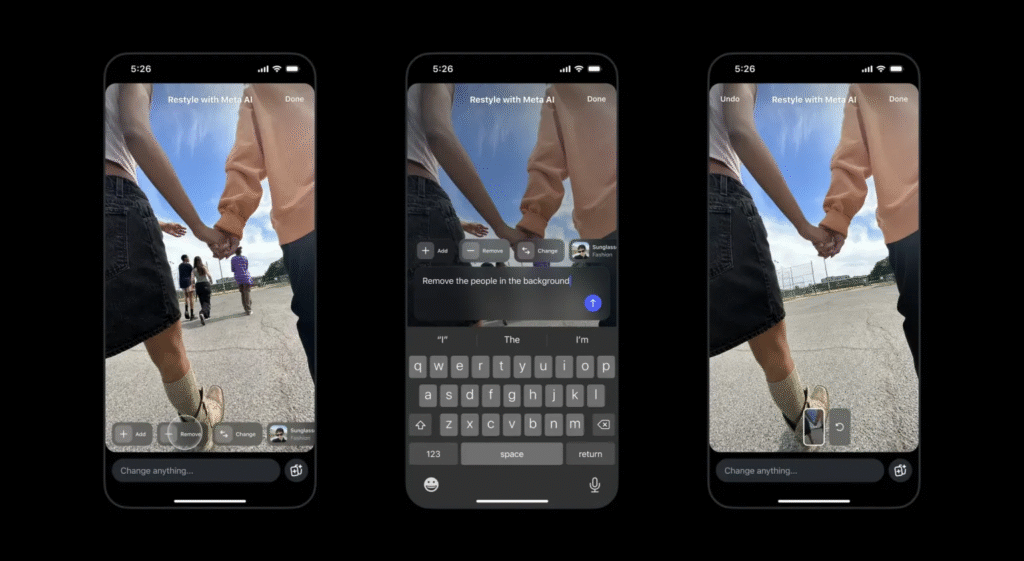
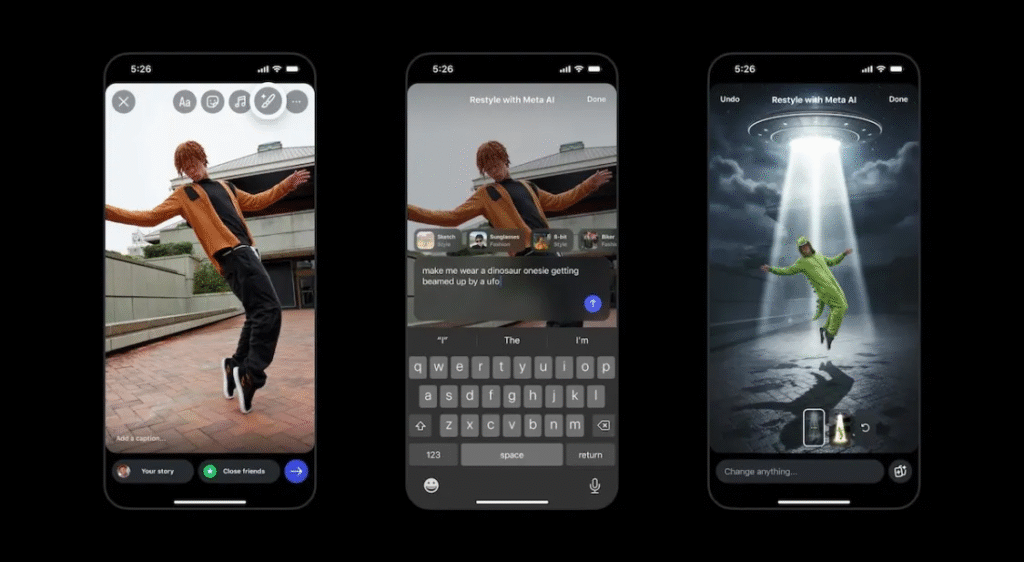
Meta is pushing deeper into AI territory with new AI-editing tools in Instagram Stories, where users can edit images and videos simply by typing in what they want to modify. From hair color to special effects, the feature upends the possibilities of creators and regular users alike to personalize their content.

Text Prompts Meet Visual Creativity

Until now, Instagram’s AI editing tools were primarily accessible through Meta AI’s chatbot, which required users to interact via direct messages. With this latest integration, however, AI editing becomes native to Stories, allowing anyone to make instant visual edits using plain language commands.

These new edit features come under the “Restyle” menu that can be accessed using the paintbrush icon in Instagram Stories. One can type commands such as “give me a sunset background,” “remove the person in the corner,” or “color my hair pink.” The AI carries out the edit one wants within seconds.

Meta suggests that users only have three primary actions to select from — Add, Remove, or Change — while specifying what they’d like to alter. The AI will automatically add objects, alter appearances, or completely restyle the photo based on what they’ve described.

Preset Effects and Dynamic Video Edits

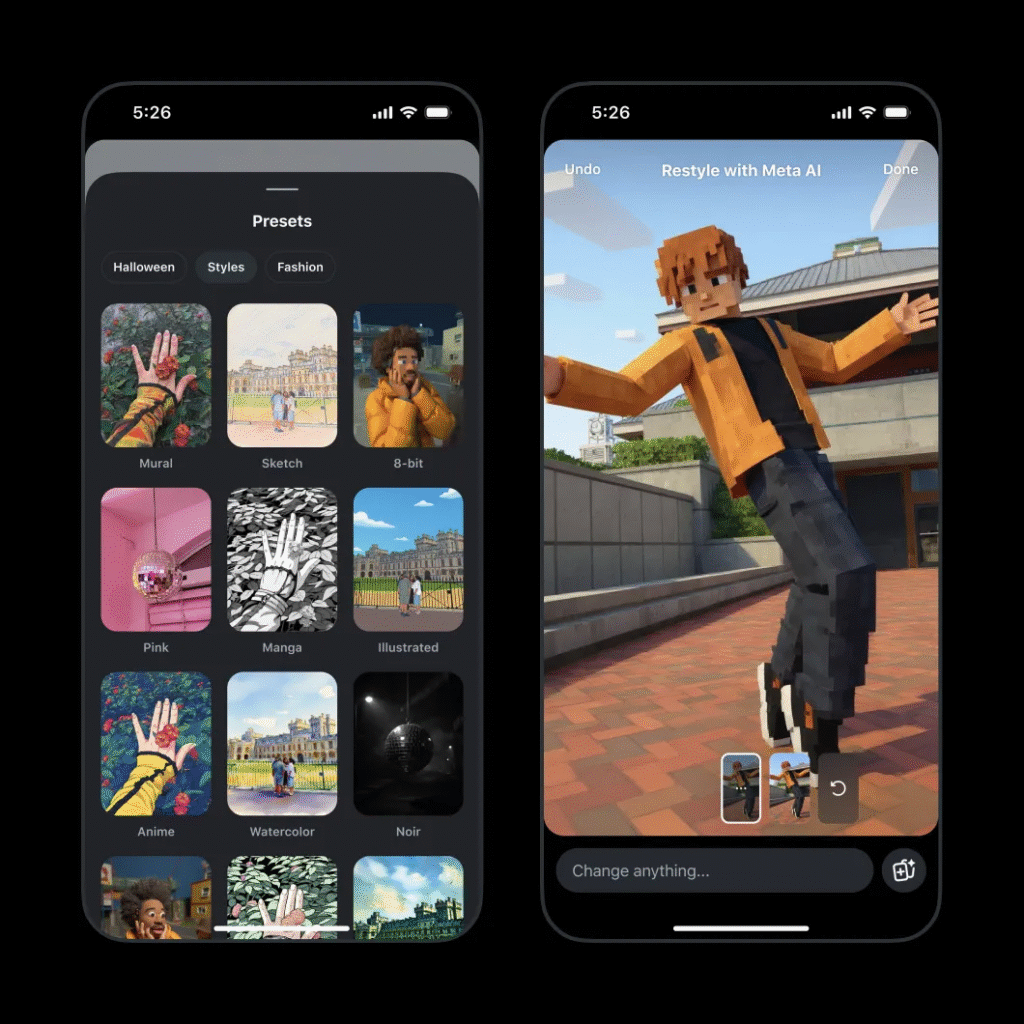
In addition to custom prompts, Instagram also has pre-select AI effects that can beautify or stylize posts. Filters like sunglasses, a denim jacket, or even a watercolor art effect can be applied.

On video content, the feature does even better — creators are able to superimpose atmospheric effects like falling snow, glowing embers, or cinematic lighting, which makes Stories appear more polished and professional without the necessity of using editing apps.

Privacy and AI Usage Terms

While the new features enable creativity, they come with privacy implications. Being used to introduce users to Meta’s Terms of Service for AI, which allow the company to “analyze photos and videos, including facial data, to make AI better.” According to Meta, it allows its systems to “summarize image contents, edit images, and generate new content based on the image.”

Critics have also had concerns regarding the ways in which such data might be used to train Meta’s broader AI models, though the company has sworn to remain committed to responsible innovation and transparency.

Meta’s Expanding AI Push

The release of AI editing software is just part of Meta’s overall strategy to roll out artificial intelligence on every platform it has, from Facebook and Instagram to WhatsApp. Recently, Meta began beta-testing a “Write with Meta AI” feature, which helps users compose intelligent or engaging comments under Instagram posts.

Meanwhile, Meta’s separate Meta AI app — with its chatbot and new “Vibes” AI-generated video stream — has been picking up steam. According to Similarweb estimates, iOS and Android daily active users rose from 775,000 to 2.7 million over a four-week span as of October 17.

Protecting Younger Users

As a response to increasing complaints from regulators and parents, Meta has also added new parental tools for its AI features. Parents may now shut off chats with AI characters and filter topics that their teens have with the chatbot to provide a safer online environment.

With these new instruments, Instagram is not only emerging as a social network but a creative platform fueled by generative AI. With Meta, OpenAI, and Google competing for leadership, this launch shows how AI is becoming more a part of the social fabric of our era — blurring the line between creativity, technology, and self-expression.

Meta is rolling out red carpet treatment for AI startups with its new Llama for Startups initiative—offering cash, technical support, and exclusive access to its AI engineering team. But beneath the generous facade lies a fierce battle for dominance in the trillion-dollar generative AI market.

What Startups Get From Meta’s Program

  • 💰 **Up to 36,000∗∗(36,000∗∗(6K/month for 6 months) in cloud credits
  • 🤝 Direct engineering support from Meta’s Llama team
  • 🔧 Early access to custom Llama model fine-tuning tools
  • 🌐 Networking with other AI-first startups

Eligibility requirements are surprisingly accessible:

  • U.S.-based incorporation
  • Less than $10M in total funding
  • At least one developer on payroll
  • Building generative AI products

Deadline to apply: May 30, 2024

Why Meta Needs Startups More Than Ever

Despite 1 billion+ Llama downloads, Meta faces mounting pressure:

🔥 Competitive Threats

  • Google’s Gemini and Anthropic’s Claude dominate enterprise adoption
  • OpenAI’s GPT-4o leads in multimodal capabilities
  • Mistral, DeepSeek, and Alibaba’s Qwen are winning open-source favor

🚨 Recent Llama Stumbles

  • Llama 4 Behemoth delayed due to underperformance (WSJ)
  • Benchmark cheating allegations on LM Arena leaderboard
  • Public vs. “optimized” model discrepancies eroding trust

💸 Meta’s Make-or-Break AI Bet

  • Projecting 2B−2B−3B AI revenue in 2025
  • Banking on 460B−460B−1.4T by 2035 (yes, trillion)
  • Spending $900M+ annually just on GenAI R&D

The Hidden Strategy Behind the Startup Play

This isn’t just altruism—it’s a three-pronged chess move:

  1. Lock-In Future Customers
    Startups that build on Llama today become enterprise buyers tomorrow.
  2. Crowdsource Innovation
    Early adopters essentially beta-test new Llama capabilities for free.
  3. Combat Open-Source Defections
    With alternatives like Mistral gaining traction, Meta needs to make Llama indispensable.

What’s Really at Stake?

Meta’s playing a long infrastructure game:

  • 60B−60B−80B earmarked for 2025 data centers
  • Revenue-sharing deals with cloud providers hosting Llama
  • Future Llama API monetization (Zuck hinted at ads/subscriptions)

For startups, the calculus is simple:
✅ Free money and support in a cash-strapped AI winter
❌ Risk of vendor lock-in as Llama evolves

Should Your Startup Apply?

The case for jumping in:

  • If you’re already using Llama, this is free acceleration
  • Early access could provide competitive edge
  • Meta’s engineering insights are gold dust for product refinement

Reasons to hesitate:

  • $36K doesn’t go far with today’s GPU costs
  • Potential IP concerns working closely with a tech giant
  • Llama’s long-term roadmap remains uncertain

The Bottom Line

Meta’s throwing a Hail Mary to cement Llama as the open-weight model of choice. For scrappy AI startups, it’s a rare chance to piggyback on Meta’s war chest—just don’t mistake it for a long-term partnership.

ADVERTISEMENT
Receive the latest news

Subscribe To Our Weekly Newsletter

Get notified about new articles